Cartomancy · Tarot de Marseille
Draw your own cards, let them answer you.
This site doesn't draw the cards for you. It teaches you how to draw your own Tarot de Marseille cards properly, then helps you interpret what you drew — using two classic, time-tested methods.
A bit of history
The Tarot de Marseille, an ancient and demanding method
The Tarot de Marseille is one of the oldest card decks used in Western cartomancy. Born in the workshops of card makers in southern France from the 15th century onward, it took the form we know today by the 17th century: 78 cards, 22 major arcana carrying the great symbolic stages of a life, and 56 minor arcana split into four suits — Wands, Cups, Swords, and Pentacles — describing daily life, action, emotion, and the material world.
Unlike more recent decks designed purely for divination, the Tarot de Marseille keeps a sober, almost geometric structure: it's the colours, the postures of the figures, and the construction of the symbols that carry meaning, more than any narratively illustrated scenes. That's what makes it a demanding tool, but a particularly subtle one, for those who take the time to really look.
This site relies on two traditional reading methods, passed down through several generations of cartomancers: the three-card reading, quick and focused, and the cross spread, more thorough, for an in-depth reading.
About
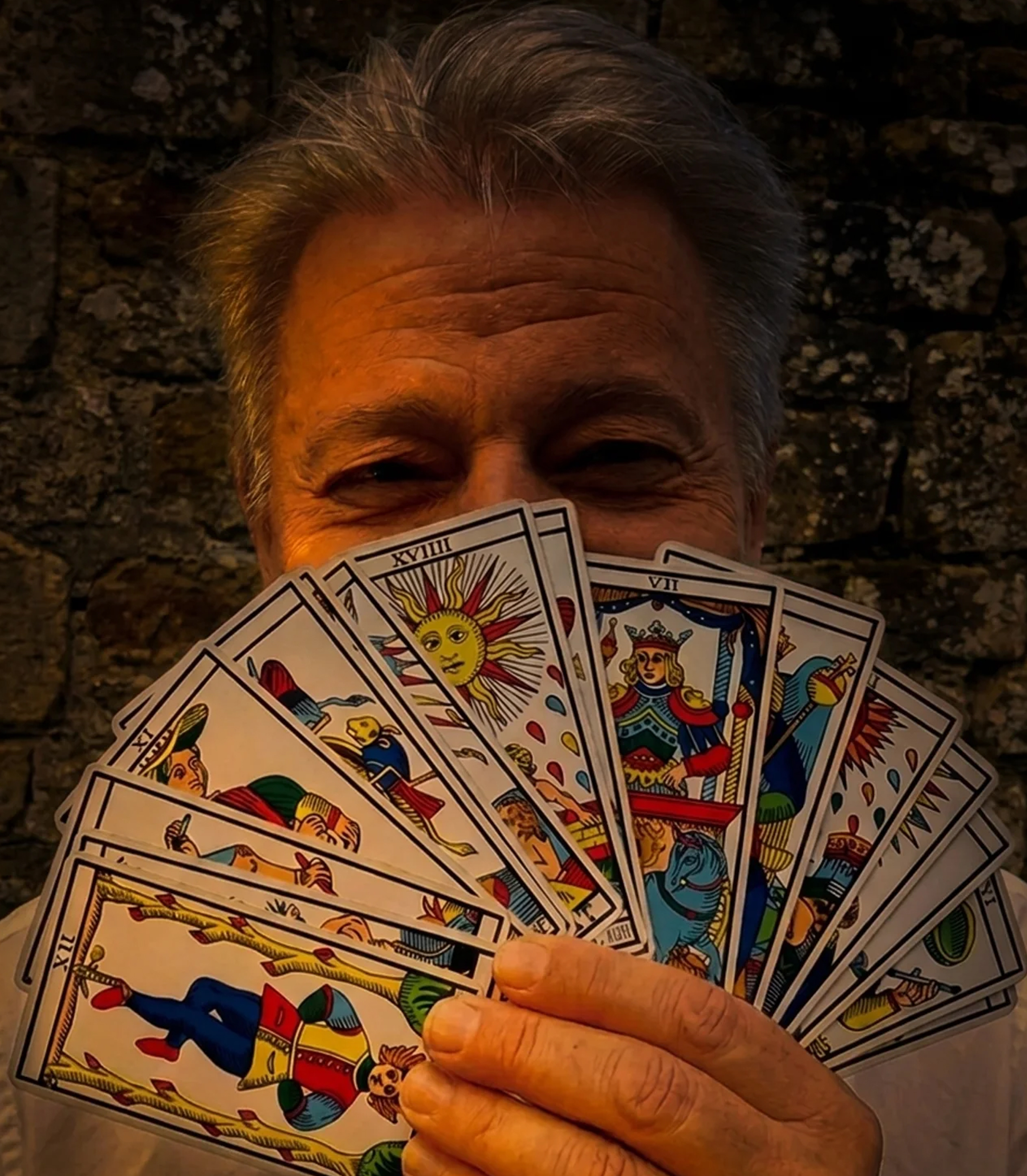
Dany, cartomancer, and the work behind this site
I've been practising the Tarot de Marseille for about a dozen years, reading for myself as well as for others. In building this site, I wanted to share something more than a ready-made reading: a method. I went back to the classic sources of French cartomancy, compared several schools of thought on the cross spread and the three-card reading, and tested this work against years of personal practice, to arrive at a clear protocol, faithful to tradition, that anyone can follow at home with their own deck.
"I didn't want a site that draws the cards for you. The act of shuffling, cutting, and laying out the cards is part of the reading — the interpretation only makes sense if you've truly drawn it yourself."
What you'll find here, then, is precise instructions for each method, a way to properly phrase your question, and a reading grid to help you make sense of what your cards show you.
Choose your method
Two classic readings, done by yourself
Each method includes the complete instructions (phrasing your question, shuffling, cutting, laying out the cards) as well as a diagram to place your cards in the right spot. Once your physical reading is laid out on the table, you enter the cards you drew to receive your analysis.
Quick & focused
3-card reading
20 €
Past / Present / Future — or Problem / Obstacle / Solution. The classic, most effective method for a precise question, with a simple protocol: shuffle, cut with the left hand, three cards laid out left to right.
- Ideal for a focused question and a clear answer
- Detailed, step-by-step protocol
- Card layout diagram
- Written analysis once the reading is entered
Full reading
Cross spread
35 €
Often called the 5-card cross spread, this is the essential Tarot de Marseille method for analysing a situation as a whole: what's working in your favour, what stands against it, the direction to take, the likely outcome, and the synthesis at the centre.
- For an in-depth reading of a complex situation
- Detailed, step-by-step protocol
- Cross layout diagram
- Written analysis once the reading is entered
Reviews
What people who've tried it say
I've always had a Tarot de Marseille deck at home without really knowing how to use it. The step-by-step instructions finally let me do a proper reading, not just flip cards at random.
The cross spread takes a bit more time, but the reading grid provided is clear, and the final analysis really puts the five cards into perspective.
I appreciate not getting a ready-made answer out of nowhere: these are my own cards, drawn at home, that the tool simply helps me re-read.